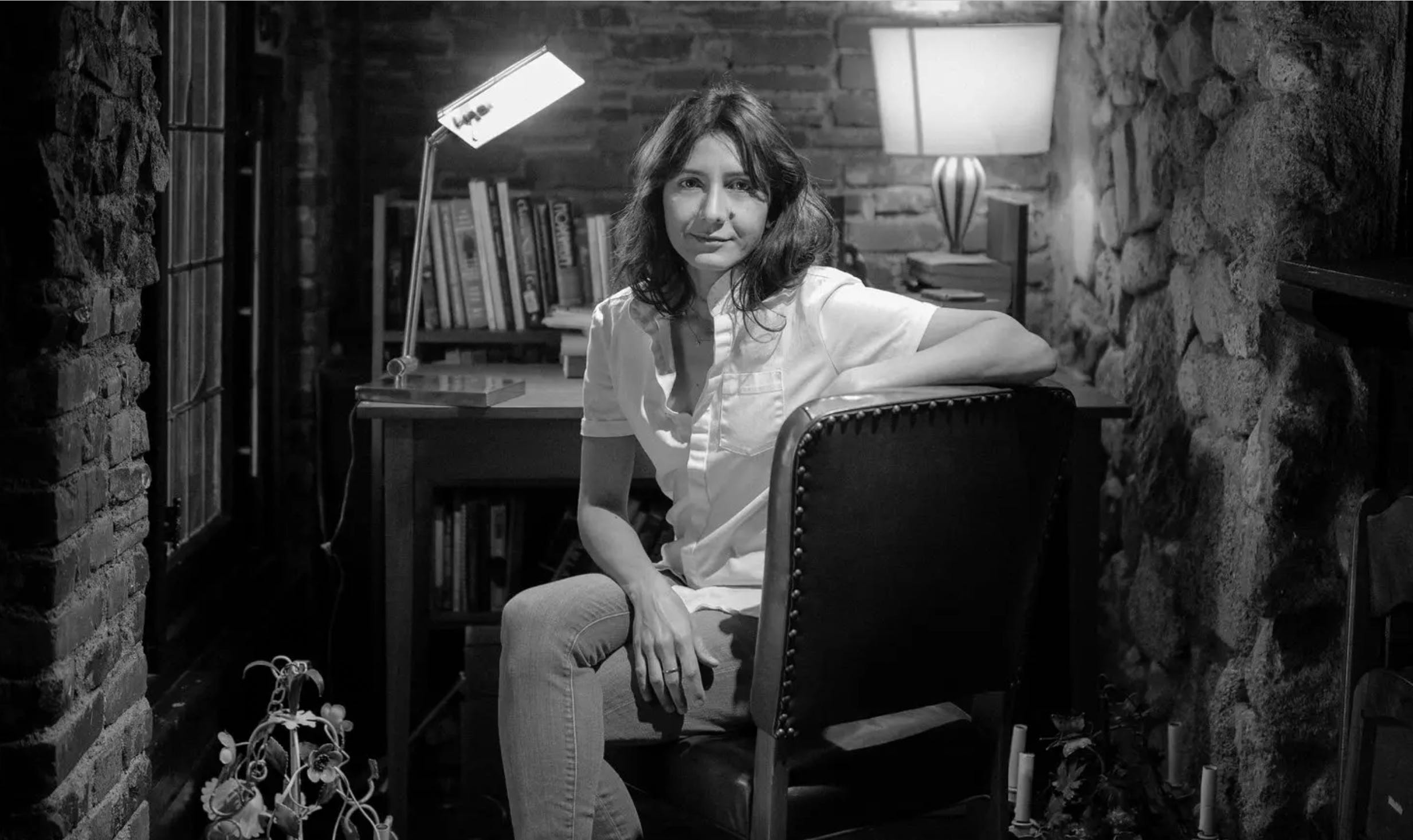
“WHAT THE FUCK. Don’t you know that you’re going to die someday?! Fucking A. You need to write immediately. Sit down and do it.” — Ottessa Mossfegh
Welcome to the first day of Essay Camp
Traditionally, I like to welcome all the participants of Essay Camp to this virtual space we are going to be sharing together over the next five days. I usually like to say that we’ve all arrived here from our various far-flung locales; we have sailed across the seas in our minds, flown over virtual cloud-capped mountain ranges, or driven through the fictional night to get here. However you managed it, rain-drenched or time-sore, if you’re reading this now, you’re here. You made it. Welcome.
For me, your weary instructor, this Essay Camp is a little bit different. My beloved father passed away unexpectedly on January 15th. I was on the phone with a nurse at the facility where he was doing some physical rehab, listening to her tell me all about how well he was doing, when the doctor called on the other line to tell me he was gone. Then, beginning that very day, my mother had a series of strokes. Scans showed that a cancer of unknown primary site (CUPS) had spread to her spine, and she entered hospice on February 16th. As I write this, about a month before Essay Camp is set to begin, they don’t expect that she will still be here by the time you read this. She is only seventy-four.
I’m not telling you about all this just to let you know how rough the past few months have been, or to place my tragedies upon you. In fact, I don’t want to do that at all. The reason I am telling you all this is because, in her last coherent weeks, my mother was talking about wanting to write. The creative impulse was flaring up in her, and she wanted to write books.
“I could write a book about—” she said multiple times, about her work, or about her experiences, both past and present; her childhood, her adolescence on the beaches of southern California with the teenage surf scene, her hippie days, the years she spent working as a mental health counselor at a federal prison; the experience of becoming, of mothering, of losing, of dying. I could write a book.
After my father recovered from an initial serious illness back in the fall of 2021, he also realized that he wanted to write books. I was helping him. We were about halfway through preparations for the first one, a memoir about his adventures in the Middle East in the 1960s. I’m going to have to find a way to finish it without him.
But you know what? He started. We made progress. I have material, and an outline, and voice notes, and leads. This will be possible. With my mother, we talked about trying to get some voice notes down once she suddenly lost the ability to use her hands a week or so after my father’s funeral, but the decline was so shockingly rapid, and the sudden need for pain medication so high, that as of this writing we have only managed to get about forty minutes of conversation recorded, and are unlikely to get more. None of it was material for books.
These two events, which are the two things I have dreaded most in the world since I first understood what mortality meant at the age of five, have both occurred unexpectedly within about a month of each other. I am in an “after” that I never wanted to find myself in, an unimaginable, impossible other planet.
At the same time, I am here. I am here with you, in this space that we imagine and create together. And I am writing. Even in this grief-blind, numb, wounded, inadequate way, I am here and I am writing. None of us really knows how much time we have to do the things we want to do, so if you want to write, do it now. Don’t wait. Do it wounded. Do it imperfect and inadequate and unsure and sick and scared. It would shock you, how not-perfect you actually have to be. As Doris Lessing famously said, conditions are always impossible. Show up, do a little, and then if you can, show up again and do a little more. You never know. One day, when I was sitting with my father a few years back, working on this memoir with him, he said:
“Wow, why didn’t I do this twenty years ago?”
I’ve never met a person who regretted having written, only people who regret what they didn’t get a chance to write.
This month, this day, for this Essay Camp, we’re just going to start. Take a deep breath, and jump into the water. No second guessing. No time for self judgement.
No regrets.
Before we begin, some basic review:
This isn’t just a writing camp, it’s Essay Camp—so, what is an essay?
An essay is famously defined as “an attempt.” That is the root of the word. It means to try—but try to do what? To understand, to clarify, to persuade, to compare, to connect, to remember, to preserve. An essay can be long or short, personal or impersonal. It can express a truth or explain a stance, introduce an idea or marry two seemingly unrelated ideas together. In that trying, the author’s thought process is often visible on the page. To write an essay is to reach for something, not so much to explain as to explore.
There’s sometimes an assumption that an essay must make an argument or tell a story with a clear lesson attached, but many of the best essays do neither of those things.
You do not have to fully understand a story or topic to write an essay about it. Not only can you write to find out what it is you think or feel about something, but doing so is highly encouraged. Many famous writers, from James Baldwin to Joan Didion, have said that they write in order find out what it is they think, feel, want to know, or don’t want to know.
A lot of beginning writers have been given the impression that in order to write a powerful essay, they must get very personal and dredge up the hardest, worst, or most interesting thing that has ever happened to them, and then write about that. That is not true. You do not have to strip-mine your trauma for content. Whether you want to “go there” or not is entirely up to you. The most important thing is to simply be honest, and to go where your interest takes you.
This week as you write, you are encouraged to tune out all external noise about right or wrong, good or bad, when it comes to your writing. Focus only on telling the truth—your truth. No one ever has to see these drafts but you, so write in whatever way feels most true to you.
Our habits, our fears, our preconceived ideas of work, art, and self, can sometimes feel like an itchy old coat that we wear day in and day out. For the next five days, let’s create a kind of warm space where we can take that coat off. Forget the self. Shrug free of routine identity. Lose your voice and walk voiceless into the place inside of you where voice does not exist. There are words there. Grab them. Take them from where they lie gleaming in the dark and carry them out with you into the light again.
Let’s begin.
“ For me writing isn’t a mental exercise, it’s barely even a literary exercise, it feels like a spiritual experience.” — Ottessa Moshfegh
Writing Assignment, Day 1
Today you are going to write. You don’t have to have any idea what to write about or where you’ll take it eventually, you just have to begin.
I invite you to use a prompt that I myself like to use, called the Five Things essay prompt. It’s an easy, open-ended way to record thoughts and observations, and connect with whatever feels most pressing. Simply open up a blank document, turn to a new page in your journal or notebook, or pull up your favorite writing app. Now, write or type the number 1. Pause for a moment, listen for the next thought that arises, and write about whatever comes to mind—an image, an idea, a memory. It can be something you saw yesterday, or something you remember from thirty years ago. If nothing arises, ask yourself “what is something that’s true?” Without judgement, write the first true thing that comes to mind. It doesn’t matter what you write, just so long as what you write is true, or feels true, to you. Write for as long as you want, without going back to read any of it. Do not retrace your steps to edit. It doesn’t have to be good, it just has to be written.
Then without reading over what you’ve just written, move on to number 2 and start again. Your second “thing” can be related to the first thing, or completely unrelated. It might be secretly related in ways you won’t realize yet. You can let each “thing” be as long or as short as you need, from a single word to many pages. When you’re done, move on to number 3, and so on, until you have completed all five things. If you’re strapped for time or sapped of energy, try just writing down one sentence each.
If you choose to write only five sentences, try taking a breath and clearing your mind before each one. Wait for the truest sentence that drops into that silence, and then write it down. It doesn’t have to be long or profound. Don’t overthink it. First thought, best thought.
Once you’ve completed all five things, that’s it, you’re done. Put your draft away and don’t think about it. Do not read it yet.
Alternate Option 1: Freewriting
If you prefer, you can can also try some good old-fashioned freewriting instead.
Set a timer for whatever amount of time you have—ten minutes, thirty minutes, an hour—and write whatever comes. As with the Five Things prompt, it’s still best for our purposes to try not to look back at what you’ve already written, as you’re writing. Do not edit as you go. Keep moving forward, without worrying whether it’s good or not, until you’ve reached the end of your allotted time.
For those who would like a specific prompt, you can try out some of these:
Write about your earliest memory, or one of your earliest memories. Is there something you can see, taste, touch, hear, smell?
Write about your parents when they were young. How did they look, sound, smell, or act? What did they dress like? What were their hobbies? How did they make you feel?
Write about yourself as a small child. Imagine yourself back inside that little body, and then finish a sentence that starts with “I see,” “I feel,” or “I want.”
Write about the first time—or one of the first times—that you found yourself performing, or pretending, for others’ sake.
Choose a memory in which music figures prominently—a party, a dance, a car ride, a date, a recital, anything—and then write about that music without mentioning any personal specifics from the memory itself.
Describe a supermarket or other food store that you don’t shop at anymore, or which no longer exists.
Imagine you’re back in high school and your best friend has just walked into the room—what are they wearing? Where are you going? (If you didn’t have a best friend in high school, describe the best friend you wish you had.)
Write about the first time you did something “bad”—smoked a cigarette, stole, lied, broke the law, kissed someone you shouldn’t have, etc.
Write about the worst haircut you ever got.
Write about a time when you were happy.
Write about a time when you were cruel.
Write about the fact that you hate writing, have no talent, or cannot write.
Write about spring blossoms, and about how seeing them makes you feel.
Write about the most boring thing you can think of. Describe, in detail, just how boring it is.
Alternate Option 2: Rebel Mode
If you’re here for the camaraderie and accountability, and plan to write something other than essays, just go ahead and work on your project for as much time as you have.
Reading Assignment, Day 1
If you want to write essays, you must be in the habit of reading them. If you have time to both read and write over the next five days, please do both. If you don’t, please prioritize the writing, but try to catch up with reading when you can. Aside from the suggested texts below, feel free to also seek out new essays, memoirs, or other writing that grabs your interest, including fiction, just so long as it is not “the news.”
For Today
If possible, I would like you to read at least one essay today. You can choose from the selection below, or find one elsewhere, in a collection or online. For this session of Essay Camp, writer Katy Kelleher is pitching in as assisting essays editor, sharing some of her own favorites with us, which you’ll see over the coming days.
For now, here are some familiar classics that show variety in length, subject, and style:
“Tiny Beautiful Things,” by Cheryl Strayed, 896 words, 4 minute read
“The Death of the Moth,” by Virginia Woolf, 1,175 words, 5 minute read (here’s an alternate online version)
“A Good Café on the Place St-Michel,” from A Moveable Feast by Ernest Hemingway, 1,639 words, 6 minute read
“Me Talk Pretty One Day,” by David Sedaris, 1,847 words, 9 minute read
“Shooting An Elephant,” by George Orwell, 3,283 words, 12 minute read
“Night Walks,” by Charles Dickens, 3,788 words, 14 minute read
“Goodbye to All That,” by Joan Didion, about 4,000 words, 18 minute read
“Total Eclipse,” by Annie Dillard, 5,589 words, 22 minute read
“Notes On ‘Camp’,” by Susan Sontag, about 6,000 words, 24 minute read
“Equal in Paris,” by James Baldwin, 6,775 words, 28 minute read
“Consider the Lobster,” by David Foster Wallace, about 7,500 words, 32 minute read
“The Fourth State of Matter,” by Jo Ann Beard, about 7,200 words, 30 minute read
Time To Write!
Without further ado, let’s get started.
Happy writing (and reading)!
xo
S
Essay Camp is free, but paid subscribers make it possible. If you’d like to subscribe at the annual rate of $30, please do so. Thank you to everyone who already subscribes.


