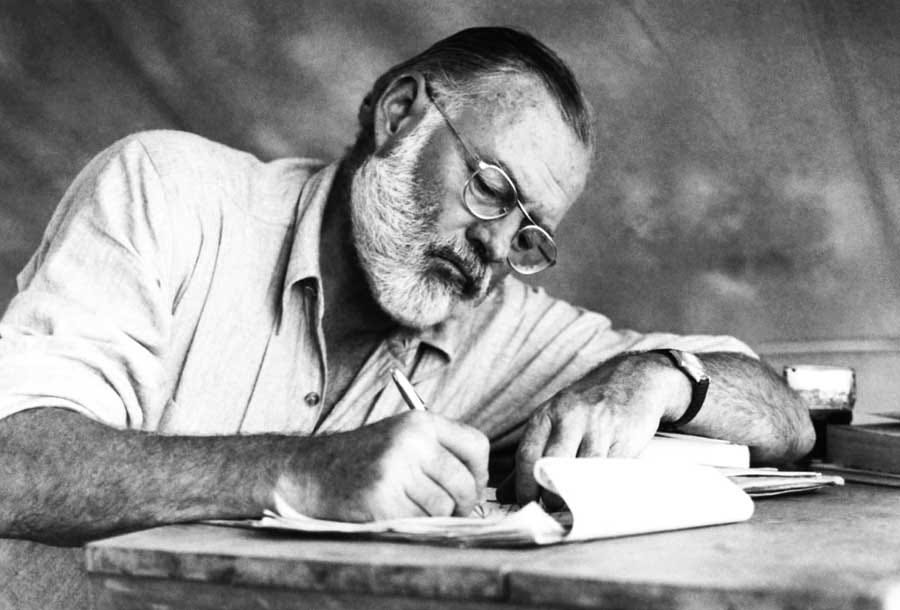
“All you have to do is write one true sentence. Write the truest sentence that you know.” —Ernest Hemingway
Welcome to the fourth day of Essay Camp.
If you’ve made it this far, well done. It’s actually quite hard for most people to commit to write every day for five days in a row and then actually do it.
Today we’re going to talk about structure. While our focus is still on writing freely and without self-judgement, as with previous sessions, I’d like to start discussing how to actually put an essay together from the various freewrites, rough ideas, and vignettes that you may be generating here. That way you can have a little extra time to think about all the different ways that your writing might take shape, before the last day.
Your assignment after the end of Essay Camp will be to finish one essay or other piece of writing. It does not have to be long, it does not even have to be good, it just has to be finished.
Finishing things is important, even so-called “bad” or mediocre things. This is probably the most important thing that you can do to help improve your writing, especially when you’re just starting out (and aren’t we all, in a way, always just starting out?). Writers, like figure skaters, must ultimately learn by doing, and it’s a very different experience to actually write an essay, story, or book, than it is to imagine doing so (I assume it works the same way with a triple axel). Imagining helps, but doing is better—and essential.
In order to finish an essay, it helps to understand a little bit about what an essay can be and do.
The essay is a funny genre—a blurry one, with undefined borders. There are few hard and fast rules. There is often an I present in an essay, a discernible speaker of some kind, but not always.
An essay is a piece of nonfiction writing that explores, argues, describes, recounts, depicts, or narrates, using literary techniques. An essay can be personal and tell the kind of story you might find in a memoir, or it can be topical, presenting one’s thoughts on a cultural or political topic. Quite often, an essay can serve as a space for intellectual curation, in which the writer brings together seemingly disparate topics or ideas, and inviting the reader to regard them in association. The essayist can put topics in conversation with one another that a reader might not have considered otherwise. It can also be much simpler than that.
One thing that distinguishes an essay from an article or an informational blog post, is the shape of it. An essay has an intentional shape. It is consciously a work of literature.
There is not a universal, mutually agreed upon taxonomy of literary essay types. Some common essay forms you might hear about are the “braided essay” or the “lyric essay,” although there is not a strong consensus on what precisely these two terms even mean. In recent years, I’ve been interested in “vignette essays,” which are a bit like lyric essays, but presented in brief snapshots, which can ideally function in a way similar to a prose poem.
Generally speaking, a braided essay weaves together two or more seemingly disparate narratives or subjects, switching back and forth between them, often with a certain sense of “coming together” at the end. A common convention with this type is to alternate between one narrative thread that is personal, and another that is less so, perhaps based on research. The different threads inform and reflect off one another. Towards the end of the braided essay, a direct connection between these threads is often revealed, or else one thread will show itself to be a kind of metaphor for the other.
The lyric essay is less specific as a genre, but the term is generally used to describe an essay that employs poetic language, and possibly an impressionistic, unconventional narrative structure, or no discernible narrative at all. It can be described as sitting somewhere between an essay and a prose poem.
There are other kinds of literary essays, too. There is the narrative essay, which tells a story in a more or less straightforward manner, with a sequential beginning, middle, and end. Many writers choose this format, and for good reason: it works.
There is the fragmented essay, presented in short, disjointed vignettes, snapshots, or aphorisms—Sarah Manguso and Maggie Nelson are both known for working in this genre.
Them there is the essay that pretends to be something else, which writer Esmé Weijun Wang has called the “mimicry essay”, like a questionnaire, an obituary, a set of instructions, or a letter. For example, in her essay “Wolf Moon,” Nina MacLaughlin presents a fanciful questionnaire intended for the moon.
You can decide what form of essay you’ll be crafting based on the material you already have.
Whatever kind of essay you choose to write, it must have a beginning, a middle, and an end. The beginning draws you in, the middle holds your interest, and the ending sees you out again. Each section has only one job, and that is it.
Like with a piece of music, the ending of an essay can have many different flavors and effects, but it must provide a sense of closure. It can crescendo to a climax, or offer a new perspective. It can end very quietly or with a bang. Some sentences simply feel like ending sentences due to the strength of their language, their imagery, or their poetic rhythm.
To borrow further from the language of music, there may also be what is known as a “recapitulation,” in which previous themes are presented again, sometimes with a secondary development. Something is repeated or called back to, but from a slightly different perspective.
Most of the time, as readers, we don’t really know why an ending feels satisfying, we just know that it does.
There is only so much you can learn about how an essay is put together, or how to properly finish one, by reading about it like this. Instead, it is better to read a lot of essays and to write some. Afterwards, you can identify why certain essay forms are effective for you, why they appeal to you, and why an ending feels satisfying. It is hard to do this without a working familiarity with the examples themselves, which can only be achieved by reading and writing.
Let’s begin.
“The first draft of anything is shit.” —Ernest Hemingway
Writing Assignment, Day 4
If you have already written three five things drafts and want to keep going, write another one today. When you’re done, if you like, you can now read back over your drafts from the previous four days and see if you like anything you’ve written. Do not panic if you hate everything that you’ve written (I cannot stress this enough), but do see if there is anything that strikes you as interesting or even good. Does it feel true? Does it make you want to write more? Are there any topics here that you’d like to expand on? Pay attention to any sentences or passages that might serve as a beginning, a middle, or an end of something..
Alternate Option 1: Freewriting
If you still have not tried the five things prompt, I encourage you to give it a try, just to see how it feels, but if you’re not working with that prompt today, proceed to freewriting instead.
Set a timer for whatever amount of time you have and write whatever comes. Try not to look back at what you’ve written. Keep moving forward without worrying about the quality of what you’ve written until you’ve reached the end of your allotted time.
When you’re finished, feel free to read back over what you’ve written these past four days and see if any parts of it feel like a beginning, a middle, or the end of an essay you might write.
In case you need a prompt:
Describe a room in which something significant happened, but without ever mentioning the significant thing.
Write about the first album (record, tape, CD, or download) that you ever bought.
Write a sentence that begins “I remember the smell of …”
Write about a favorite piece of clothing that you no longer own.
Write a series of questions intended for someone or something that cannot respond.
Write an open letter to a person or entity that is unlikely to respond.
Write about blossoms.
Write about a house.
Alternate Option 2: Rebel Mode
Do your thing. Work on your own project in whatever way you see fit for as long as you can.
Reading Assignment, Day 4
For today’s reading assignment, select an essay to read, either from those listed below, or one you missed from a previous day. After reading, think a little bit about its structure. What kind of essay is this? How does its structure inform your experience of the material?
“Passing Mary Oliver at Dawn,” by Summer Brennan, 764 words, 3 minute read
“A Woman’s Work: Home Economics,” by Carolita Johnson, 1,075 words (plus comic illustrations), 5 minute read
“Natural Intelligence,” by Maria Popova, 1,538 words, 6 minute read
“The Face That Replicates,” by Katy Kelleher, 2,620 words, 10 minute read
“The Heaviest Pain in the World,” by Rob Delaney, 4,240 words, 17 minute read
“Chicxulub,” by T. Coraghessan Boyle (a short story), 4,374 words, 18 minute read (this is not an essay, but rather a shorts story that uses a braided narrative structure)
“Dreamers in Broad Daylight,” by Leslie Jamison, 7,271 words, 29 minute read
“The Reenchanted World,” by Karl Ove Knausgaard, translated from the Norwegian by Olivia Lasky and Damion Searls, 10,766 words, 43 minute read
“Ugly, Bitter, and True,” by Suzanne Rivecca, about 16,000 words, 1 hour 10 minute read
“Bluets,” by Maggie Nelson,” about 28,000 words, 2 hour read
Time To Write!
There was a lot of information today, so let’s get to it.
Happy writing!
xo
S
Essay Camp is free, but paid subscribers make it possible. If you’d like to subscribe at the annual rate of $30, please do so. Thank you so much to everyone who already subscribes!


