Still Life
Going Through Old Notebooks Part 25: "I remember falling in love with a girl in Paris once. I was eighteen. Nothing happened."
The rain coming in, and a change in the way the air smelled. Something I couldn’t quite name. It was smack in the middle of January and already the hint of things to come: frangipane king cakes in all the bakeries, and yellow mimosa in the flower shops.
I thought, I think I’ll go somewhere, maybe Seville. What is it like there at this time of year? When do the trees blossom? When does the fruit appear? Is there fruit? Are there really orange trees in the city streets? Do the alleyways flicker with torchlight? Are there castanets? Will the past be there? Where is Alicante, that place from a poem I read in my high school French class by Jacques Prévert? “Une orange sur la table, ta robe sur le tapis?” That love story, contained in a still life. Valencia? Maybe I’ll go there.
Out in the night air, the dark evening, colder than before, but still relatively warm, still well above freezing, there were swans bathing and preening in the shallow water of the stone ramp near the Pont des Arts. I didn’t understand what I was seeing at first, there in the dark, their white bodies twisting in ways that my brain couldn’t categorize. Strange creatures at the water’s edge, becoming something other than what they are. No wonder Leda was confused.
I remember falling in love with a girl in Paris once. I was eighteen. Nothing happened. We were staying in the same apartment. I intended to write “somewhere in the ninth” just now, but wrote “somewhere in the night” instead. It was somewhere in the night, too. She was a stranger, a friend of a friend, older than me. We were staying there together by chance, alone, a fortuitous overlap. Me in a sleeping bag on the living room sofa, and she in a big wooden bed in the next room. We stayed in, stayed up late; at three in the morning she cooked ratatouille, braless in a sea-green sweater. I had a boyfriend back home. Late June or early July, the sky stayed blue until midnight. In the morning we had warm baguettes and apricot jam. I never saw her again. In an old diary somewhere, I still have her picture.
Rain coming down, collecting as crystals in the branches.
I went to an exhibit at the Louvre about still life art through the ages, all those flowers and fruits and vegetables and dead birds. There was a still life painting from Pompeii, from 50 A.D., of a loaf of bread and two figs. The figs, exactly as they might be now, set in the light on the windowsill. The bread, like you or I might eat, sectioned, like an ancient Roman tear-and-share. We have been ourselves for so much longer than we realize. Bread, and figs on the ledge of a window, and the Neapolitan sun beating down. The sounds of the ocean not far away. In the distance, for all of us, the sound of the volcano.
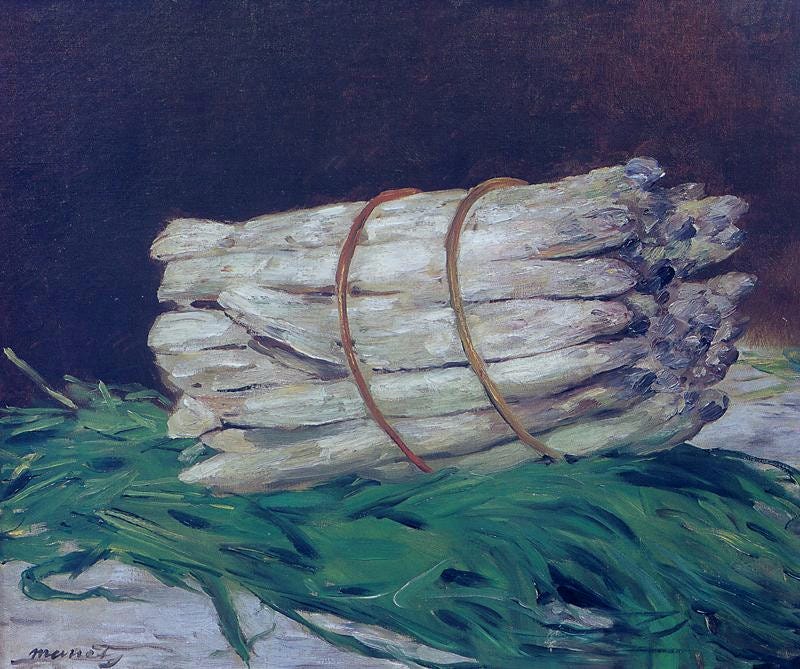
There was the bundle of asparagus as painted by Manet, which I saw for the first time in person. It was larger than life and bright as yesterday. Van Gogh, Cezanne, Gauguin, Matisse; the seashells and cherries, cakes and plums, loaves of bread and apricot jam on a Paris table in the morning—but no, that was just my memory. Meals prepared by a girl you’ll never see again. Piero Manzoni, who preserved his breath in a balloon.
At the end of the exhibit, there were large projections of the final scene from Antonioni’s Zabriskie Point; the exploding wardrobe, the exploding television, the exploding refrigerator. Destruction in slow motion, violent as divorce. The blue sky filled with flying shirts like paint splatter, scattered oranges and shrapnel and carnations.
Things, accumulating and passing out of existence. Fruit spoils and disappears. Manet is long gone and in his grave in Passy, and the asparagus in the still life—did someone eat it? Did his wife, Suzanne, peel and cook it for their supper? Did she make a cream sauce? Or did it stay in the studio until it was too soft to eat, and get tossed out? Manet, gone now, and Suzanne gone too. The asparagus, gone. But the painting, the light, that moment—preserved. The painting keeps traveling forward, long past the point when we cannot.
In the Tuileries after, in the gray January day, all the duck ponds were dug up, all the fountains dry. Things change. Trees are chopped down. But I don’t like it. As always, as dear Edna St. Vincent Millay would say, I am not resigned. The ducks, affronted, stood on the lawn and did not know what to do with themselves.
Adapted from a notebook entry written in 2023.
Enjoy my writing and want to support it? Become a paid subscriber today. You’ll get full access to craft talks, essays, notebook entries, sketchbook pages, and the popular semiannual write-along workshop Essay Camp. You can also buy my books The Oyster War and High Heel, “like” my posts by tapping the heart icon, share them on Substack Notes or other social media, and/or send them to a friend.