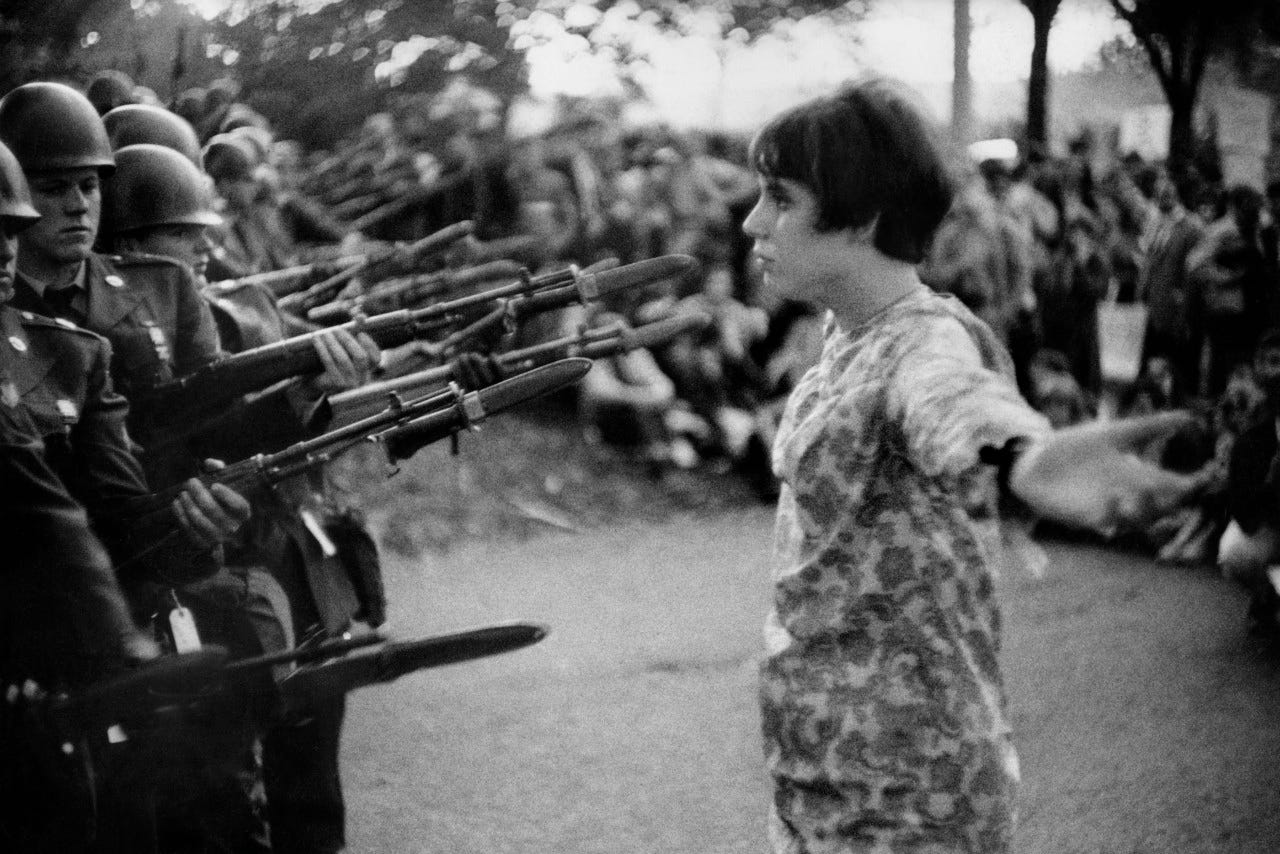
The American Resistance
This, too, is here. It's been here all along, even if they mocked it.

Before reading anything else that I have to say on this topic, I invite you to watch (or re-watch) this video from Minnesota governor Tim Walz, posted three days ago:
This is real, and this is happening. The occupation and invasion of U.S. cities and states by the rogue forces of American fascism is underway. This is the dismantling of American democracy in real time, before our very eyes.
If you’re still confused about whether this truly is fascism, as in, actual, literal fascism—as I wrote in my most recent post—it is. It is also a test: Trump wants to know what he can get away with, and it is our job—our imperative, vital job—to tell him: nothing. He can get away with nothing. None of this will be tolerated, and any and all violent and illegal actions will be held to account. Maybe not today, but as Governor Walz implored citizens in this video, we must witness, and we must record, and we must document, and we must resist. Keep your phone handy. We must not be goaded into violence ourselves, for that is what he wants. But nothing will be forgotten or ignored, and that day of accountability will come.
“The Party told you to reject the evidence of your eyes and ears. It was their final, most essential command.”
— George Orwell, 1984
In early November of 2016, feeling dismay over the result of the presidential election, and the carnival of gleeful violence that I saw starting up around me, I tweeted something about it—I can’t remember what—and then, without even really thinking, included the hashtag #resist. I hadn’t seen anyone else use it. I would be surprised if I was the first, but I don’t know. I don’t generally use hashtags now, but this was another time. The website formerly known as Twitter has now been so gutted that it may no longer be possible to find out who actually started it, but I imagine it was probably multiple people at once.
For me, it came from an internal place; a moral place; a place of unquestioning certitude. Even in that dark moment of history, I had discovered that inside the fear and dismay and rage, there was also a calm center, with a strong word inside of it, and that word was: no.
No to this, and no to what was about to happen, and no to what was going to happen in the next year or two, and for the next ten-plus years or more after that.
And most of these things did, indeed, happen.
I, like many others, knew immediately that it was the end of Roe v. Wade; that along with the loss of the right to abortion—signalling that women are people, not livestock—all pregnant women were now vulnerable. They would now no longer be protected from prosecution for murder if they miscarried; they could be accused of killing their own children while grieving natural losses, be denied care, and die of sepsis. All of this has since happened.
This is not meant as an “I told you so,” and nobody likes a scold. It makes sense that the unthinkable was, well, unthinkable. But some of us knew that authoritarianism had come to America; that it would be built on lies and the irrational will of the supreme leader, and force, and a massacre of logic, truth, and laws, both international and domestic. We knew that NATO would be mortally threatened if not outright destroyed. (That is the real point of Trump’s fixation with Greenland: it threatens our NATO allies.) We knew that people in America and abroad would be abducted and killed, that men carrying guns would execute citizens in the street, that people would be disappeared to camps or black sites, and that the institutions that held up American democracy would be weakened and start to fall.
And yet somehow, often, over the past decade, the idea of “resisting” the homicidal politics of Trump and his goons became something to make fun of. Those of us calling for resistance were an easy target. Maybe it was the marches of women wearing knitted hats that certain men simply could not stomach, no matter how liberal they claimed to be. A lot of the loudest and earliest such voices were women, and the dismissal of us as irrational, hysterical, overreacting, unintelligent, and uninformed, was entirely predictable but no less shocking. It did not matter that many of us were highly qualified or at least more informed than many a talking head on television. It did not matter that I myself had, at that point, close to a decade of experience leading a United Nations press team in high level meetings for the UN Disarmament and International Security Committee, the Security Council, and other bodies. A woman had run for president, and that woman did not become president, and so it was decided that women were at fault for this, and should therefore be punished, shamed, and ignored. And so we were.
Now things are changing. The blatant authoritarian destruction of America has become undeniable. Even the men with podcasts and baseball caps and scruffy beards who usually dismissed such things are now saying “oh hey look, wow, those ‘resist lib ladies’ were right after all.”
The American Resistance does not and will not look like the resistance movements of the past. The world has changed, and the forces and means of oppression and brutality have changed, and so it will be different. Just as this iteration of fascism looks and works differently than those of the past, so too will the deeds necessary to dismantle it, but resistance is necessary nonetheless.
As I said in my last post, I don’t know that I have anything uniquely helpful or insightful to say about any of this in this moment. However, as Snyder’s lesson No. 9 from On Tyranny says: “Think up your own way of speaking, even if only to convey that thing you think everyone is saying.”
I am just one person, and do not in this moment have the emotional or physical capacity to learn everything, know everything, explain everything, be an “expert” on this moment, or even to go and put my body on the line in protest. But I feel called to engage with this moment of crisis in whatever way I can. The American Resistance is real, and necessary, and it is happening—on the streets, in our homes, and in the way we choose to care for one another, in this very moment. I’d like to write in dialogue with Snyder’s On Tyranny and other resonant texts, and share those thoughts, and hear the thoughts that you, the readers of this newsletter, have to share as well.
As Governor Walz said: you are not powerless, you are not helpless, and you are not alone.


Just FYI, Trump apologist nonsense or other dismissal of the severity of this moment will be deleted, so don't bother. A U.S. state is having to deploy the state National Guard to protect itself against violent actions of the Federal Government.
As a Queer Black Latiné person I am used to be labeled as "extreme" and I'm used to my ideas being called "liberal". I'm also used to my reactions being called "dramatic" or "exaggerations". This is not new to me. I will keep fighting the good fight by witnessing, staying informed, and engaging in dialogue with others.