The Atmosphere Advances
Going Through Old Notebooks Part 32: On the vibrating beingness of Seurat’s pointillist paintings.

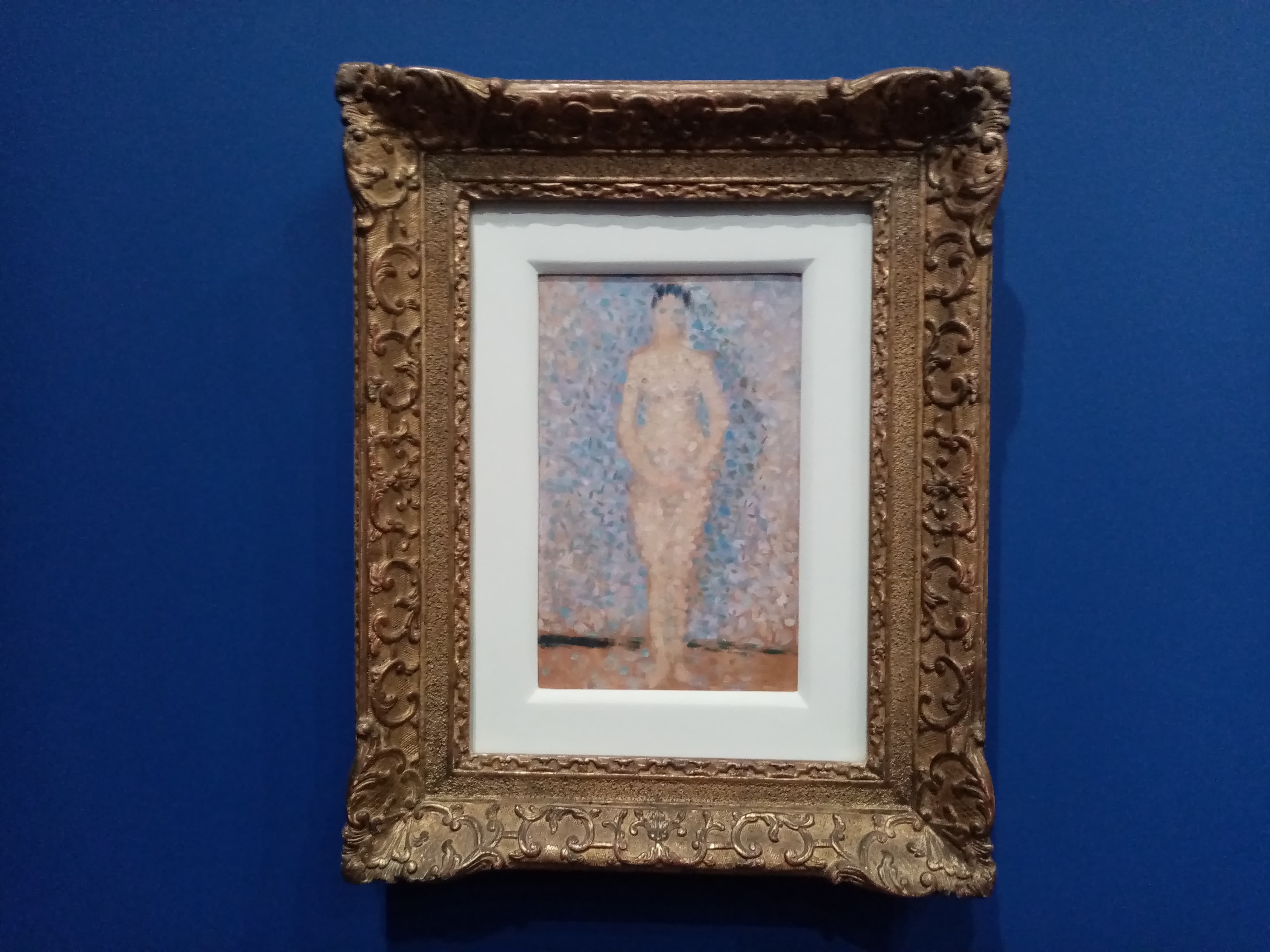
On a Friday in February several years ago, I went for a third spin through an exhibition of works from the collection of the painter Paul Signac at the Musée d’Orsay. It was the show’s final weekend, and I wanted to get one last look at a small painting by Signac’s contemporary and fellow pointillist, Georges Seurat. It was an oil study of a model standing nude in an atmosphere of blue and lilac brush marks.
I was immediately drawn to this study the first time I saw it. It’s no bigger than a piece of writing paper, and was in danger of being eclipsed by the largest Seurat on display, The Circus, which was hung nearby—an unfinished painting of an acrobat performing on horseback in the ring. Even so, this little study demanded my attention.: the particulate blue light floats in front of the model’s body, coloring her skin, but also catching her up in a swirl of atmosphere, like a little cyclone of vibrating beingness. The colorful aura reminded me of the air on a beach at dusk, when you can almost see the negative ions shimmer, all forms revealed as a swarm of atoms, electric. In these moments, the atmosphere advances to debunk the myth of material solidity.
Signac acquired the study, now called Poseuse debout, de face, shortly before Seurat’s death. He liked sketches as much as finished paintings, and noted in 1895: “What charm emanates from these smiles and thoughts of a painter.”
Something about Seurat’s work just pulls you in. It does indeed possess a sense of vibrating electricity. The blur of colored dots promises to reveal something, if only you’d move closer, but then the nearer you get to the canvas, the more the paintings atomise.
Sitting on the bench near the Seurat study, I watched it grab people, watched them fall into it, the way that Alan Ruck’s character Cameron does when he encounters Seurat’s A Sunday Afternoon on the Island of La Grande Jatte1, his most famous work, at the Art Institute of Chicago, in John Hughes’s 1986 movie Ferris Bueller’s Day Off. Of the scene in which Cameron stares and stares at the mother and child in the painting, squinting to get better resolution, Hughes later said in a recorded commentary: “I always thought this painting was sort of like making a movie, you know, the pointillist style, in which you’re very, very close to it; you don’t have any idea what you’ve made until you step back from it.”
But in Ferris, Cameron does not step back. The closer he looks, the less he sees. He falls into it, experiencing a kind of personal dispersal. The abstracted field of color composing the child’s face mirrors back to him his own facelessness, his lack of belonging, his fear, as Hughes put it, that “there isn’t anything there.”
All painting is a form of optical illusion, but pointillism—the technique Seurat pioneered in the 1880s, when he was only in his twenties—aimed to deconstruct the act of seeing itself. Trained at the Paris École des Beaux-Arts, Seurat studied classical art, but he was also keenly interested in how the eye interprets color. He was drawn to the theories of chemist Michel Eugène Chevreul, who explored the chemical properties of color after becoming director of the historic Gobelins tapestry factory in 1824, originally a manufacturer of medieval dyes. He observed that two colors, when placed near to one another, would look like a third color when viewed from a distance. He called this effect “simultaneous contrast.”
Chevreul advised painters to incorporate these color “contrasts” into their work. Seurat, who copied paragraphs from Chevreul’s works out in his own notebook, was interested in the way this contrast effect evoked emotion. This visual manifestation of emotion, as Seurat experienced it—a sense of blurred vibration—is part of what makes his works so captivating.
As artist David Hockney notes in his book Secret Knowledge2, for centuries, painters had increasingly preferred what he calls an “optical look.” This was the world as seen by the eye, rather than the imagination, or more precisely by a lens, mimicking the life-like projections of light and form made by reflecting devices, such as a mirror or a camera obscura. The goal was, ostensibly, to present life as we actually saw it, as opposed to the more symbolic depictions seen in pre-Renaissance art.
With the advent of chemical photography in the mid-19th century, lens-produced images could now be affixed to surfaces and widely shared, rather than just experienced as live phenomena, and painting began to change. Many felt that it was no longer needed as a documentation tool in quite the same way that it had been for thousands of years. Some even argued that painting itself would soon become obsolete.
Painters of this era, while certainly still influenced by the proliferation of photography and the optic image, therefore increasingly began to occupy themselves with what black-and-white photography could not yet capture. While photography replicated the stationary and the concrete, these painters sought to emulate the ephemeral and the fleeting. Impressionists like Claude Monet and Berthe Morisot turned their eye to mists, to dusk, to the dappled colors of light on water, to the movement of air across a woman’s bare shoulders in the glow of a low-lit dressing room. If a photograph was a moment frozen in time, painting remained fluid, temporally as well as physically. It still breathed, and could defy the pinned stagnation of the shutter speed.
If the impressionists liberated colors from their former margins, making color and light the very subjects of the works themselves, Seurat endeavored to go even further. His goal was to get at the truth behind the truth—or perhaps truth behind the illusion—of what it really means to see.
But again and again, life slides away from us, meaning slides away, as does our idea of the concrete self. The mind wants patterns in the same way that the eye wants colors to merge. We are built to do this. We want definition and borders. Sometimes however, no matter how hard we try to keep it together, we cannot.
In Elena Ferrante’s 2011 novel My Brilliant Friend, the character Lila confesses the frightening episodes she refers to as “dissolving margins:”
“[O]n those occasions the outlines of people and things suddenly dissolved, disappeared … It seemed to her that everyone was shouting too loudly and moving too quickly. This sensation was accompanied by nausea, and she had had the impression that something absolutely material, which had been present around her and around everyone and everything forever, but imperceptible, was breaking down the outlines of persons and things and revealing itself.”
But the dissolution of our own margins need not be frightening. In Richard Linklater’s 1995 film Before Sunrise, Julie Delpy’s Céline and Ethan Hawke’s Jesse come across a poster for a Seurat exhibition as they stroll through nighttime Vienna. Because they are only in Vienna for one night, they are going to miss it.
“I love the way the people seem to be dissolving into the background,” Céline says. “Look at this one. It’s like the environments, you know, are stronger than the people. His human figures are always so transitory.”