

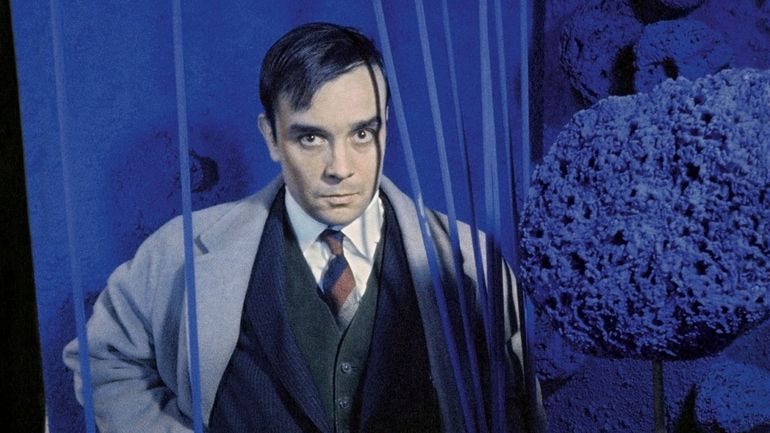
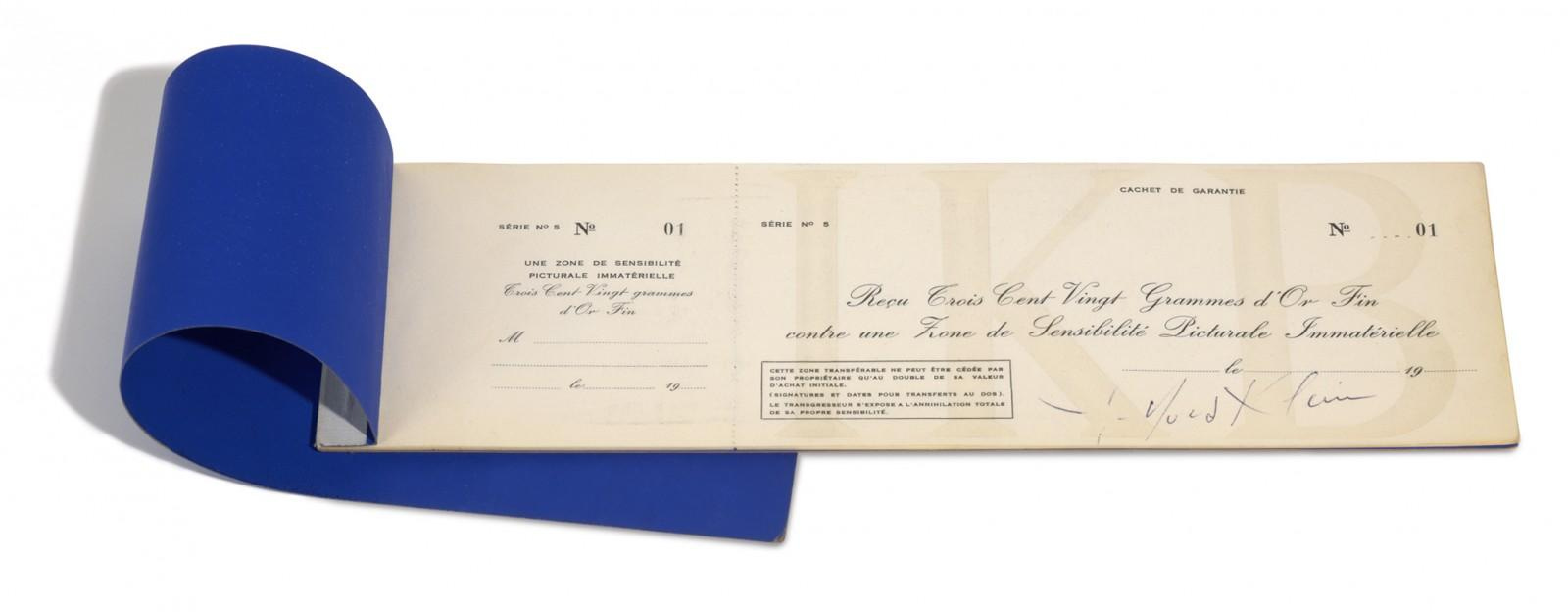
In 1959, the French artist Yves Klein sold certificates of authenticity for nothing. For the price of “three hundred and twenty grams of fine gold” (about €17,000 today), buyers became the proud owner of one “zone of immaterial pictorial sensibility”—that is to say, physically, nothing at all. Not a canvas or a sculpture or even a container. You could say it was the air in a room where Klein had held an exhibition (an exhibition of nothing, for the room was “empty”), but it was not really even that; not the air, or even the space that the air had occupied, but the concept of that air, the pictorial sensibility of the air in the space with which Klein had imbued it.
This sensibility had a color, although it existed only in the minds of the artist and the viewer, and that color was blue.
To process the sale of the zones, Klein had counterfoil notebooks made up, like old fashioned tear-away checks. On the outside was a cover of deep, highly saturated, ultramarine blue. This was International Klein Blue, a color he had started to make the central focus of his work the year before, in striking monochrome canvases and sculptures. He would later register it with the French National Institute of Industrial Property—not quite a patent, but similar. He created the highly pigmented color with Parisian art paint supplier Edouard Adam, using synthetic binding agents to allow the shade to retain its matte intensity.
But once a buyer had purchased one of the zones, the certificate was torn off and separated from the blue. In much the same way that visitors to the exhibition of the zones had passed through a blue curtain to find themselves in a blank white room, a room (filled with “zones”) in which the blue was to be imagined, the buyers left the blue behind.
Klein was born in Nice in 1928 to artist parents. He studied at the National Merchant Navy School, and then at the School for Oriental Languages. He was a Judo prodigy, and even traveled to Japan to complete his studies. One day at the age of nineteen, as he lay on a southern French beach with two friends, they decided to divide the world between them. Arman, a painter, chose the earth. Claude, a composer, chose words and the world of language. Yves chose the atmosphere surrounding the planet and the depths beyond that stretched into infinity. That is to say, the sky. The sky, he said, was his first great artwork, a readymade to end all readymades, and with a flourish of his arm, he signed it.
