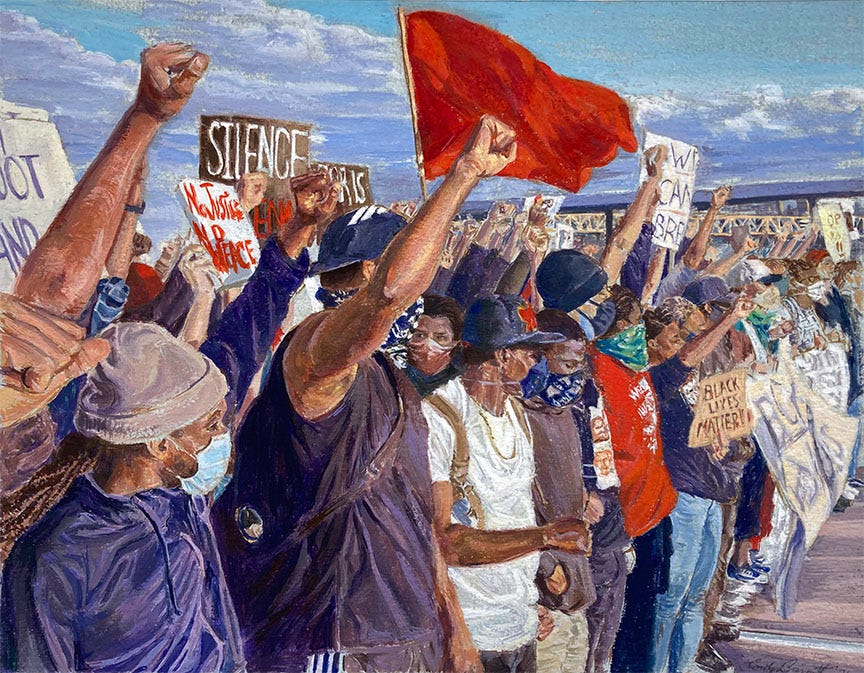
Why Do Americans Accept The Extrajudicial Killing of Civilians By Police?
Some thoughts.
Once, while boarding a flight to Seattle from Frankfurt during Covid, the German captain came on the loud speaker to make an announcement. He said that passengers needed to respect the rules and wear a mask at all times, except when eating or drinking. If not, they would be detained and turned over upon landing to the American police.
“Und as you know,” the captain said, an unseen smile coloring his accented voice, “ze American police are not so lenient as ze ones in Germany!”
Several passengers chuckled. A young white man sitting in front of me, an American, turned to the young German beside him, whose long blond hair was pulled up into a messy man-bun, and said:
“That’s funny, because in America, like, we’d think that German cops would be more strict and scary and stuff, you know? We’d never think American cops would be seen that way by Germans!”
“But it is in America that the cops can kills you,” the German replied, completely serious.
The longer I spend living outside the United States, the more often I think about this fact. I think about it so often, that it has become indistinguishable from the mere invocation of the country of my birth; that in America you can fail to use your turn-signal, or drive a little too fast, or even do nothing at all but simply cross paths with a cop who views your very existence as a threat to his own existence, because of what you look like or appear to stand for, and you’re dead; show the wrong attitude and they might kill you; and maybe there will be justice, but most likely not, and in either case it won’t bring you back because you’re dead, murdered by the State. Like, that’s a thing that can just happen, as though it were an accident, when it was not an accident at all.
I actually wrote the above few paragraphs before the murders of Renée Good and Alex Pretti by ICE agents in Minnesota. This was a problem before outright fascism came to America under Trump. It happened under Biden, and Obama, and Bush, and Clinton, and so on. Unless something drastic changes, it will only get worse.
I see French people yelling at the police sometimes, for example after or during protests, like quite close to them, and think: in America, insubordination is punishable by death, and not just death, but instant death, via extrajudicial killing. Having a bad attitude is punishable by death. Having a mental health issue in the vicinity of a police officer can be punishable by death. So is simply not wishing to be submissive or humiliated.
That death is one of the possible outcomes for an unarmed person in America when encountering the police—or, frankly, even an armed person carrying something like a hammer or a knife—and that we simply go on with our days when this is the reality, is strange and unacceptable. I mean, we stage protests, or some of us do. Sometimes many of us protest, and some of us make it their whole lives and whole worlds to stop it, but historically, it hasn’t been enough. I mean “not all Americans,” etc., right? But where have we heard that argument before? Not enough of it has come from positions of real political power. That the ever-present threat of death by police can be a shruggable fact about life in America makes me feel like I can never live in America for any long stretch of time ever again.
This is not normal. Not just what we’ve seen under the invasion of Minnesota by Trump’s secret police; not just the murders of Renée Good and Alex Pretti that ICE has carried out, but all of it: George Floyd, and Breonna Taylor, and Michael Brown, and Eric Garner, and Philando Castile, and Tamir Rice, and Elijah McClain, and Ronell Foster, and Ismael Mena, and Amadou Diallo, and Tyisha Miller, and Don Myrick, and Malice Green, and Phillip Pannell, and Eleanor Bumpurs, and Michael Stewart, and Arthur McDuffie, and Eula Love, and Bernard Whitehurst, and Fred Hampton, and Bobby Hutton, and some 30,000 other people shot and killed by police in America between just 1980 and 2016 alone.1
The American police are armed because, ostensibly, the American public is armed. American officers claim that they are in constant fear for their lives because of this. This, they say, is why people are shot while holding things like wallets and lighters and toys and phones. But what about the many people shot in the back simply for running away? This is not an offense punishable by death in America. All offenses that are punishable by death still require a trial, a jury, a judge, and yet—since the days of the murders of Black Panther members Fred Hampton and Bobby Hutton and before, American police will say that your murder was justified because of who you were or what you stood for.
In Europe, some national police are armed, while some are not. Still there is not nearly the same scale to the problem of police killing civilians. Perhaps this is because there is not the same assumption of an armed populace. In 2021, the French police, who are armed, killed 37 people. In the United Kingdom in 2019, where police are not armed, except for special response units, they killed only three. In the United States in 2022, police killed 1,096 people.2
We all know how it goes by now, and you don’t need me to tell you—the desperate grasping for a criminal record, no matter how minor—for any victims of police violence, including the names I mentioned above. Most of those murders were obviously motivated by racial hatred, and yet if someone once committed a robbery, or bought or sold drugs, then their murder is justified? It isn’t, but somehow, enough Americans are pacified that they let it go. They still feel that the police are safe, that the person murdered was an “other,” a criminal, and criminals by nature must accept the possibility of death, or so the argument might go.
I think this comes in part from the fact that the death penalty still exists in America. It is one of only five other countries in the whole world that still allow the practice, the others being Iran, Iraq, Saudi Arabia, Yemen, and China.3 I think that even if you live in a part of the country where the death penalty has been abolished, Americans still have this idea sitting somewhere at the back of their minds, that State murder of its own citizenry is sometimes justified. This, along with the assumption of an armed populace, is used by agents of the State to occasionally kill whomever they want.
Now, even if you have no criminal record, the State can invent one for you. They can call you a domestic terrorist, arrest you, and doctor the images so it looks like you were hysterical when you were not. It’s the whole “first they came for” argument, but also maybe the “Are we the baddies?” meme. It’s not that nobody cares or has cared. Lots of people care. But on the whole, politically, America has shrugged, and it has gone on, and these are very scary times indeed, and certainly new lines are being crossed, but even so, this problem started a long time before the current administration.
It’s pretty clear who the baddies are shaping up to be as we enter this second quarter of the 21st century. If America can get to an after for this moment—and I sincerely hope it can—it will have to be one in which the police has been demilitarized, in which the State is not authorized to kill its citizenry for any reason. One of the great privileges and benefits of living abroad is to see that, while other countries also suffer their own problems, their own prejudices, and their own bloody pasts, there really is a different way of doing things.
Enjoy my writing and want to support it? Become a paid subscriber today. You’ll get full access to craft talks, essays, notebook entries, sketchbook pages, and the popular semiannual write-along workshop Essay Camp. You can also buy my books The Oyster War and High Heel, “like” my posts by tapping the heart icon, share them on Substack Notes or other social media, and/or send them to a friend.
https://www.thelancet.com/journals/lancet/article/PIIS0140-6736(21)02145-0/fulltext
https://worldpopulationreview.com/country-rankings/police-killings-by-country
In some instances, it’s not completely clear cut which countries can still be considered to have capital punishment, as certain countries in Africa will allow for the death penalty in extreme instances such as war crimes, etc, but these are the main six. You can read more of the details here.


I believe that this is one of the unintended consequences of weak gun control laws in the United States. American police (and now Canadian police) have to assume the person they are pulling over has a gun. German police probably see this as a less-likely threat.
I'm not saying that stronger gun control laws would solve everything -- this is a complex issue with many things at play. I'm not saying that Americans *should* give up Amendment rights. I'm not saying police have any and all rights to do whatever they want and then claim self-defence, or that they have no rights at all.
I'm saying that when there is a very real prospect that the person you pull over has a gun, you will have a much different decision-making process, and your reactions will be different. Any underlying biases you have that inform that decision-making process in the heat of the moment will have a profound impact on that decision and the subsequent outcome.
This, I think, explains part of what's happening.
And the other aspect is that the odds of a cop successfully being prosecuted for murder is incredibly low, even if its caught on camera as we saw with Floyd (or if they are found guilty they win on appeal). I think a lot of it is also related to soldiers becoming cops when they leave the army and their police trainers also being ex-army so they have that occupying mindset that believes everyone is a threat. Secondly, thanks to a weird DoD deal, the police can pick up ex-military equipment for free or cheap, which is why they have humevees and assault rifles and look like paramilitary squads, which makes no sense for a civilian agency.
There's one other disturbing aspect of American policing. Unlike Europe, the police can seize your property and the onerous is on you to prove it wasn't funded by criminal activity. This is without a trial, and if you're undocumented people really don't want to get involved in trying to get their stuff back. Some towns in the mid-west fund their police force directly on these seizures from people driving through their town.
https://en.wikipedia.org/wiki/Civil_forfeiture_in_the_United_States